How to build an aftercare follow-up plan
Published 19 October 2026Reviewed 19 October 20267 min read
On this page
Why should aftercare be planned?
Follow-up without a plan depends on someone remembering. In a busy week the call gets put off, the patient does not know whom to ask, and a problem is noticed late. With a plan, it is clear who is due today, who contacts them and what is asked.
Patients are told to ask about this in advance. The NHS advises people considering cosmetic surgery abroad to ask where follow-up appointments will be, what happens if there are complications and what aftercare will cost. A 2023 joint statement by BAAPS and TSPRAS, the British and Turkish aesthetic surgery associations, says patients should know their surgeon's name and how to reach them, and that the surgeon should offer an aftercare plan.
What should the plan set out?
- Which treatments or services it covers.
- Contact days counted from the treatment day, for example days 1, 7 and 30.
- Who reaches the patient each time: coordinator, doctor or front desk.
- The channel, and the language the patient is spoken to in.
- What is asked: how they are, any question, whether they want a call; clinical questions as the doctor specifies.
- Which photos: area, angles and lighting, as the doctor describes.
- The escalation rule: which answers go to the doctor the same day.
- Documents for the patient: the doctor's care instructions, any warranty or certificate.
- When the plan ends.
What does a sample follow-up schedule look like?
This is an example of structure, not a clinical protocol. Your doctor sets the days, questions and photos for each treatment.
- Day 1
- Who makes contactCoordinator
- What is asked or requestedHow the patient feels (good, okay, not good), whether they have a question, whether the instructions are clear
- When it goes to the doctorAny “not good”, any question and any request for a call, the same day
- Day 7
- Who makes contactCoordinator
- What is asked or requestedGeneral state, the photos the doctor asked for, a check-up appointment if needed
- When it goes to the doctorPhotos for the doctor's review; any answer raising a concern, the same day
- Day 30
- Who makes contactCoordinator or doctor
- What is asked or requestedGeneral state, photos, satisfaction
- When it goes to the doctorAs the doctor's criteria say
- Day 90
- Who makes contactCoordinator
- What is asked or requestedGeneral state, photos, the date of any further check-up
- When it goes to the doctorAs the doctor's criteria say
- Months 6 and 12 (depending on treatment)
- Who makes contactCoordinator
- What is asked or requestedA reminder of the long-term check-up, final photos
- When it goes to the doctorAs the doctor's plan says
Who should contact the patient?
The coordinator handles routine contact: sends the message, reads the answer and rings the patient. Clinical assessment and every treatment decision belong to the doctor; the coordinator never interprets an answer or says “that's normal”, but passes it to the doctor and relays the reply.
Each patient should have a named follow-up owner they know, with a clear stand-in for leave or departures. Contact patients abroad at sensible hours in their time zone and in their language.
Which questions should be asked?
The coordinator's questions are short and non-clinical. Adding clinical questions, such as about pain, swelling or medication, and interpreting the answers is the doctor's job.
- How are you feeling? (good, okay, not good)
- Is there anything you would like to ask us?
- Would you like us to call you?
- Is anything in your instructions unclear?
- Which days would suit you for your next check-up?
What should you watch for when asking for photos?
The doctor decides which area is photographed, from which angles and in what light. Give the patient a sample photo or a short description; photos taken from the same angle each time are easier for the doctor to compare.
A photo of the treated area says something about the patient's health, and both Türkiye's KVKK and the UK GDPR treat health data as a special category of personal data. Keep photos off staff members' personal phones and somewhere secure that only those who need them can open. Using follow-up photos in marketing needs separate consent; agree the wording and process with your lawyer.
When should a matter go to the doctor?
Write the escalation rule down in advance so nobody has to make the call alone. Follow-up messages are not an emergency channel: before treatment, tell the patient what to do in an emergency, in instructions written by the doctor.
- When the patient says “not good”: the same day.
- When the patient asks for a call, or asks something the coordinator cannot answer from the doctor's written instructions: the same day.
- When photos requested for the doctor's review arrive: within the time the doctor sets.
- When the patient misses two contacts in a row: the coordinator rings, and if they cannot reach the patient, tells the doctor.
- Every time, the doctor's decision and what the patient was told are recorded.
What if the patient does not reply?
If a check-in gets no answer, send one more message, then ring, and record how many times you tried. After a set period, close it as unanswered so that your open list shows only work that is really waiting.
Track the response rate month by month. If it is low, revisit the wording, timing and length of the message; a short check-in that takes a few taps is easier to answer than a long form.
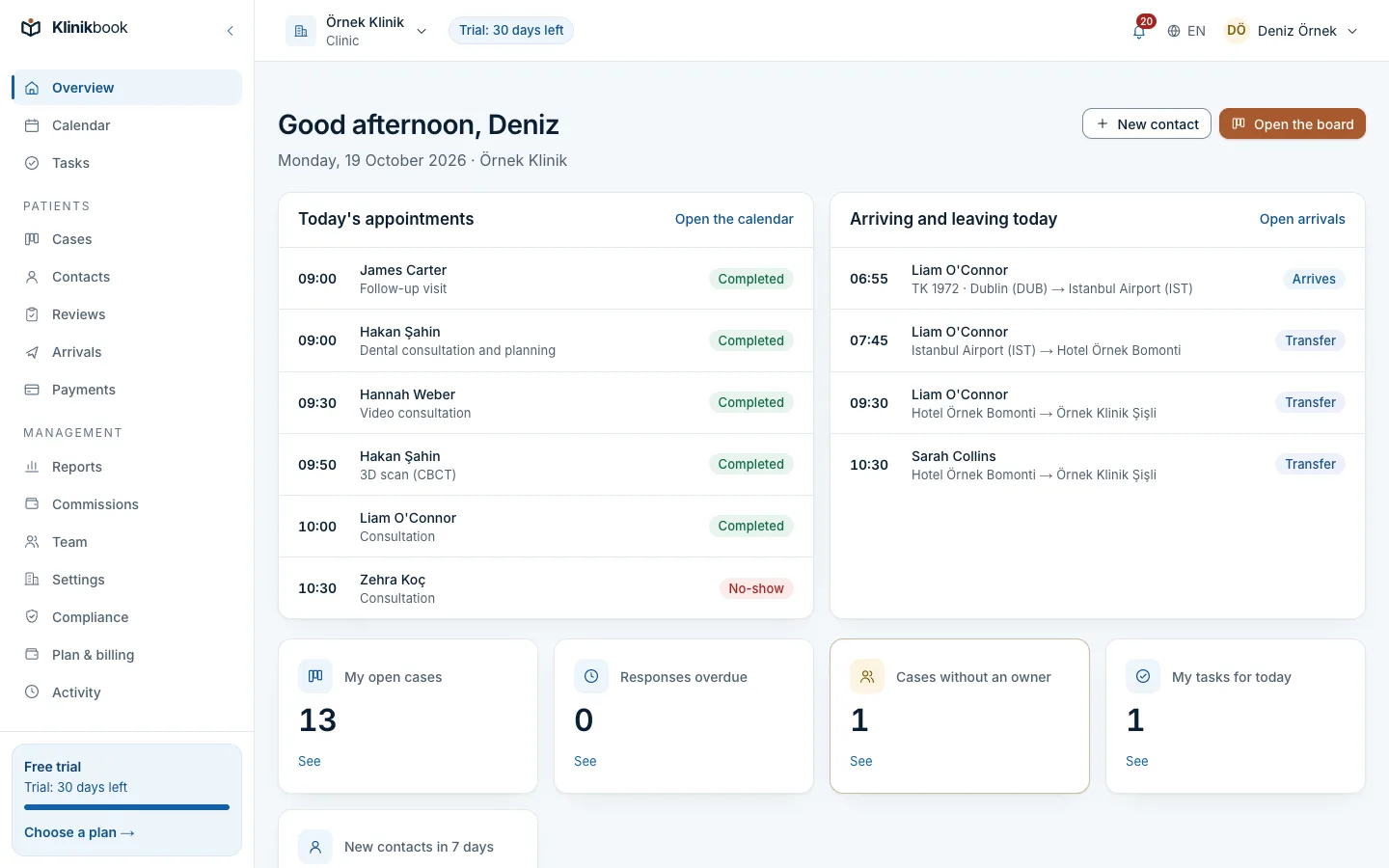
How do you do it in Klinikbook?
Klinikbook keeps no medical records. Its check-in questions are deliberately a fixed, non-clinical set: how the patient feels, a question for the clinic, photos and a request to be called.
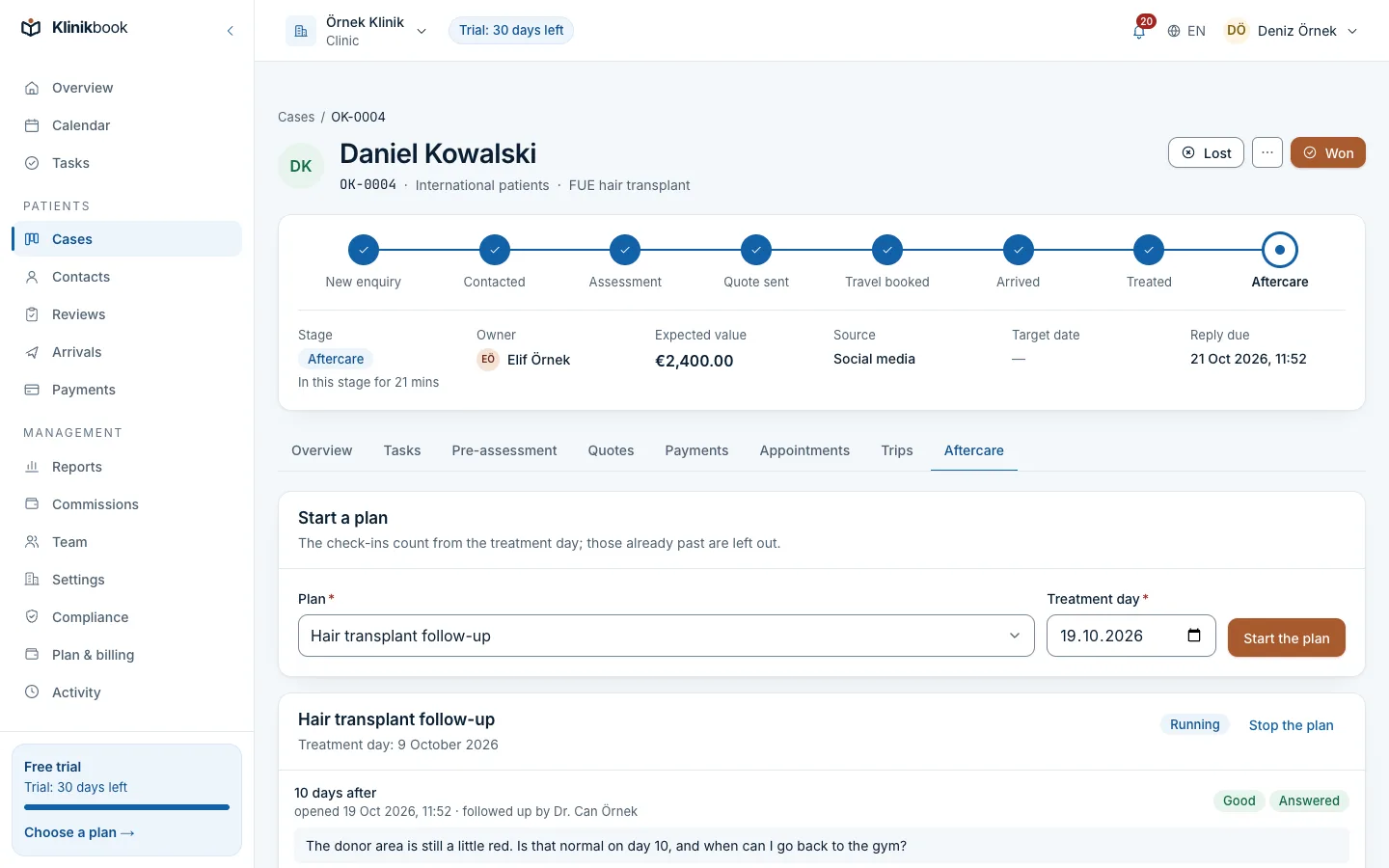
Set up a plan per service
For each plan, set the days, the message in Turkish and English and who follows up, once.
It starts by itself
When a case moves to “treated”, its plan starts from that day; you can also start one on a case by hand.
An e-mail and a task on the day
The patient gets a link to answer and the person following up gets a task. A question or a call request becomes a task with a response target.
The patient answers on the portal
The patient answers the short questions, adds photos and finds documents such as care instructions on the portal. The portal never judges an answer; it tells anyone with a concern to call the clinic.
Frequently asked questions
How long should aftercare follow-up last?
It depends on the treatment, and the doctor decides. What matters is that the plan has an end point and the patient knows when follow-up finishes.
What should we do if a patient sends photos on WhatsApp?
Move it securely into the patient's record and do not leave it on a staff phone; have a written rule for this and review it with your lawyer.
Can we use follow-up photos in our marketing?
Only with the patient's separate consent for that purpose; follow-up and marketing are different purposes. Prepare the consent wording with your lawyer.
How do we follow up patients who live abroad?
With the same plan, adjusted to their time zone and language. Before treatment, agree with the doctor what happens if a check is needed near the patient's home, and give the patient that in writing.
Can I add clinical questions to check-ins in Klinikbook?
No. Because Klinikbook keeps no medical records, the check-in questions are fixed: how the patient feels, a question for the clinic, photos and a request to be called. Clinical assessment stays with the doctor and their own records system.
Sources
- Cosmetic surgery abroad — NHS, last reviewed 14 December 2022
- Joint statement from the BAAPS and TSPRAS — British Association of Aesthetic Plastic Surgeons (BAAPS), 23 June 2023
- What is special category data? — Information Commissioner's Office (ICO)
- Law No. 6698 on the Protection of Personal Data, Article 6 (in Turkish) — Mevzuat Bilgi Sistemi (official legislation database of Türkiye)
Related reading
30-day free trial
Try Klinikbook with your own team
Every feature is open for 30 days, and no card is needed to start.