On this page
What does a no-show cost a clinic?
An empty slot is more than a lost fee. The practitioner's time, the room and the equipment sit idle, and a patient who could have used that hour has been pushed further down the diary.
It is not only a private-clinic problem. In April 2024 Türkiye's Ministry of Health said 23 million people who booked through MHRS, the public hospital booking system, did not turn up in 2023, and announced that patients would have to confirm the day before or lose the slot.
How do you measure your no-show rate?
Over a month, divide missed appointments by the total of attended and missed ones. Count late cancellations separately: the patient did tell you, but the slot usually stays empty all the same. Rescheduled appointments are not no-shows.
Then break it down by appointment type (first consultation, check-up, treatment day), by source and by how far ahead it was booked. Problems usually cluster in one place, and that is where your effort should go.
Which appointments are most likely to be missed?
In the same review, the two most consistent signals were:
- A long gap between booking and appointment. Offer the earliest slot you can, and if it is weeks away, get in touch once more in between.
- Patients who have missed before. Rather than penalising them, confirm by phone or message the day before, ask what got in the way and offer a time that suits them better.
When should reminders go out?
This pattern is a good starting point for most clinics. Keep it to three reminders at most: the aim is to inform the patient, not to bury them in messages.
- When the appointment is booked
- What goes outThe details: day, time, address, practitioner, how to cancel or change
- WhyAny mistake is caught at once
- 7 days before (distant appointments only)
- What goes outA short reminder
- WhyChanged plans surface early and the slot can be reused
- 24–48 hours before
- What goes outA reminder that asks for an answer: “I’ll be there” or “Cancel”
- WhyTime to ring those who have not answered and to refill slots
- On the day, 2–3 hours before
- What goes outDirections and what to bring
- WhyFor early-morning appointments, send it the evening before
- If the patient did not come, the same day
- What goes outA friendly call or message
- WhyOffer a new time and find out what happened
Which channel should reminders use?
Most of the evidence is about text messages and phone calls. A Cochrane review from 2013 found that text-message reminders improved attendance compared with no reminder at all, with results similar to phone calls. The authors rated the evidence as low to moderate quality.
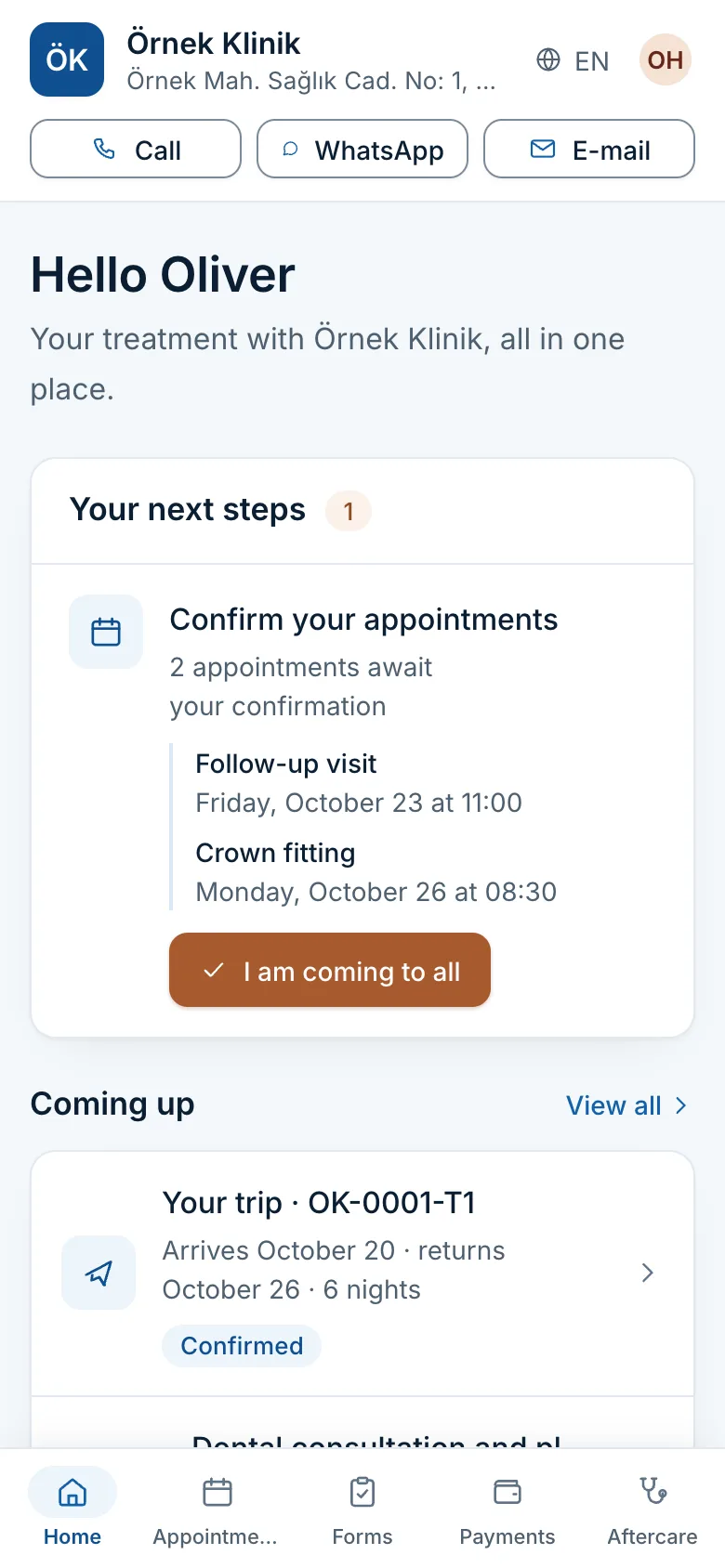
In practice, the right channel is the one your patients actually read. E-mail carries detail well, such as the address, a map link and a list of documents, and suits patients travelling from abroad. Make someone responsible for confirming by phone or WhatsApp those who have no e-mail address or do not reply.
What should a reminder say?
- The clinic's and the patient's names, so it is clear who is writing.
- Day, time and time zone; for patients coming from abroad, say whose local time it is.
- The address, a map link and any parking or entrance details.
- Who the patient will see and the type of appointment, with no clinical detail.
- Documents to bring, such as ID, previous test results or a form to complete.
- A one-tap way to confirm or cancel, and a phone number that someone answers.
- The patient's language: their own, or at least English if they do not speak yours.
Why does making cancellation easy help?
A patient who has to ring, wait on hold and explain themselves to cancel often just does not come. A cancel link in the reminder turns a silent no-show into a patient who lets you know.
Set a cut-off for cancelling, for example 24 hours before, and state it clearly in the booking details. After the cut-off the patient should still be able to call you: the point is not to shut the door but to avoid an empty slot.
How do you fill freed slots?
- Keep a short list of patients who would like an earlier appointment, and ring them first when a cancellation comes in.
- If you have an online booking page, let the freed slot reappear there at once; it does part of the job for you.
- Make someone responsible for checking the day's unconfirmed appointments each morning and ringing those patients. Reminders only work fully with someone like that behind them.
What changes for patients travelling from abroad?
In health tourism the appointment is part of a trip, so settle the appointment, hotel and transfer together before the patient books a flight. Give times in the clinic's local time and say so, check flight details before arrival, and keep the trip and appointments in one place so that a changed flight carries through to everything else.
How do you do it in Klinikbook?
Klinikbook sends reminders by e-mail; it does not send SMS.
Choose your reminder times
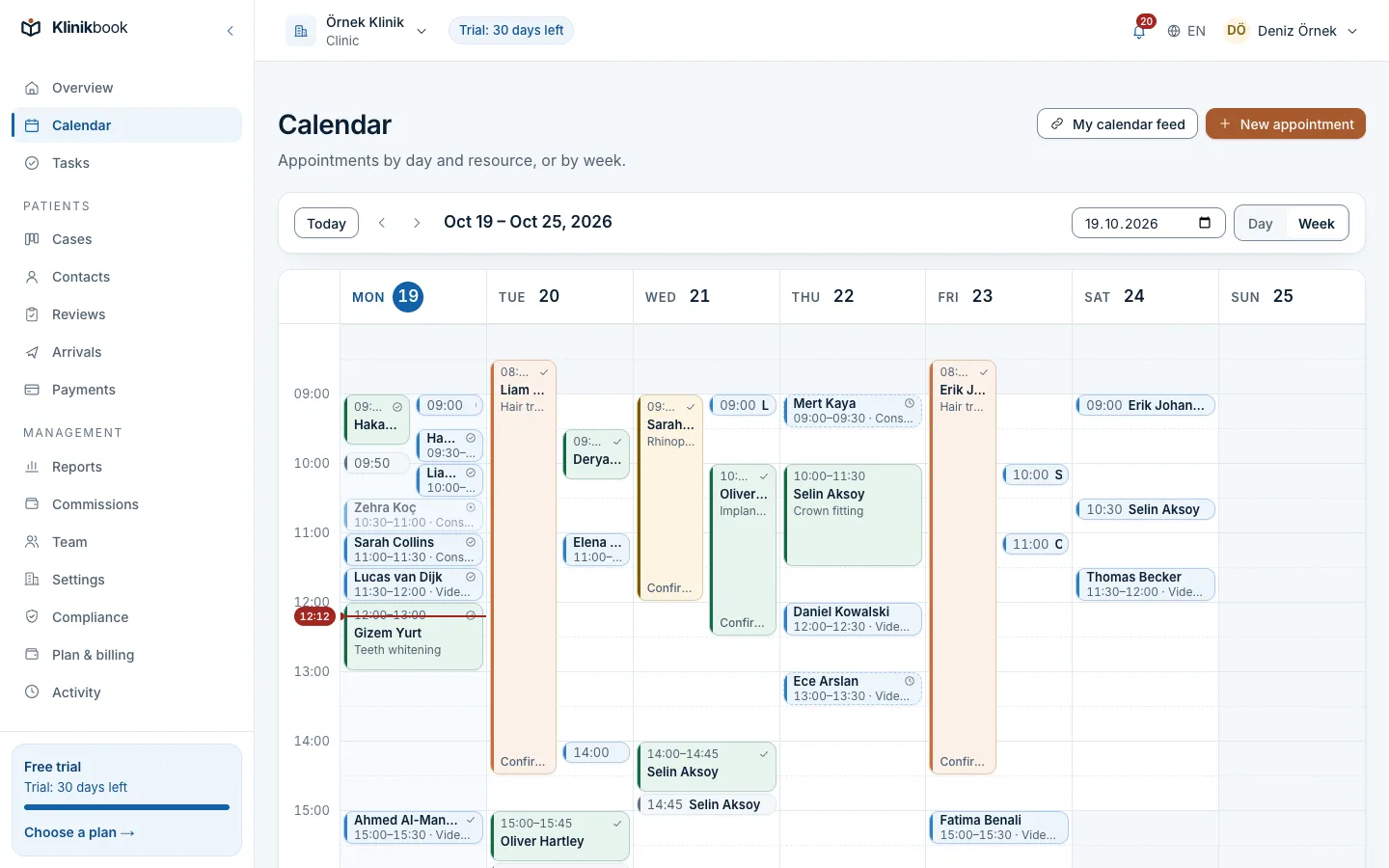
In the booking settings, pick up to three reminder times between 2 hours and 7 days before the appointment. The e-mails go out in the patient's language, with a link to confirm or cancel.
Set your cancellation rule
Decide whether patients can cancel online and until when. A cancelled slot reopens on your booking page.
Ring those who have not confirmed
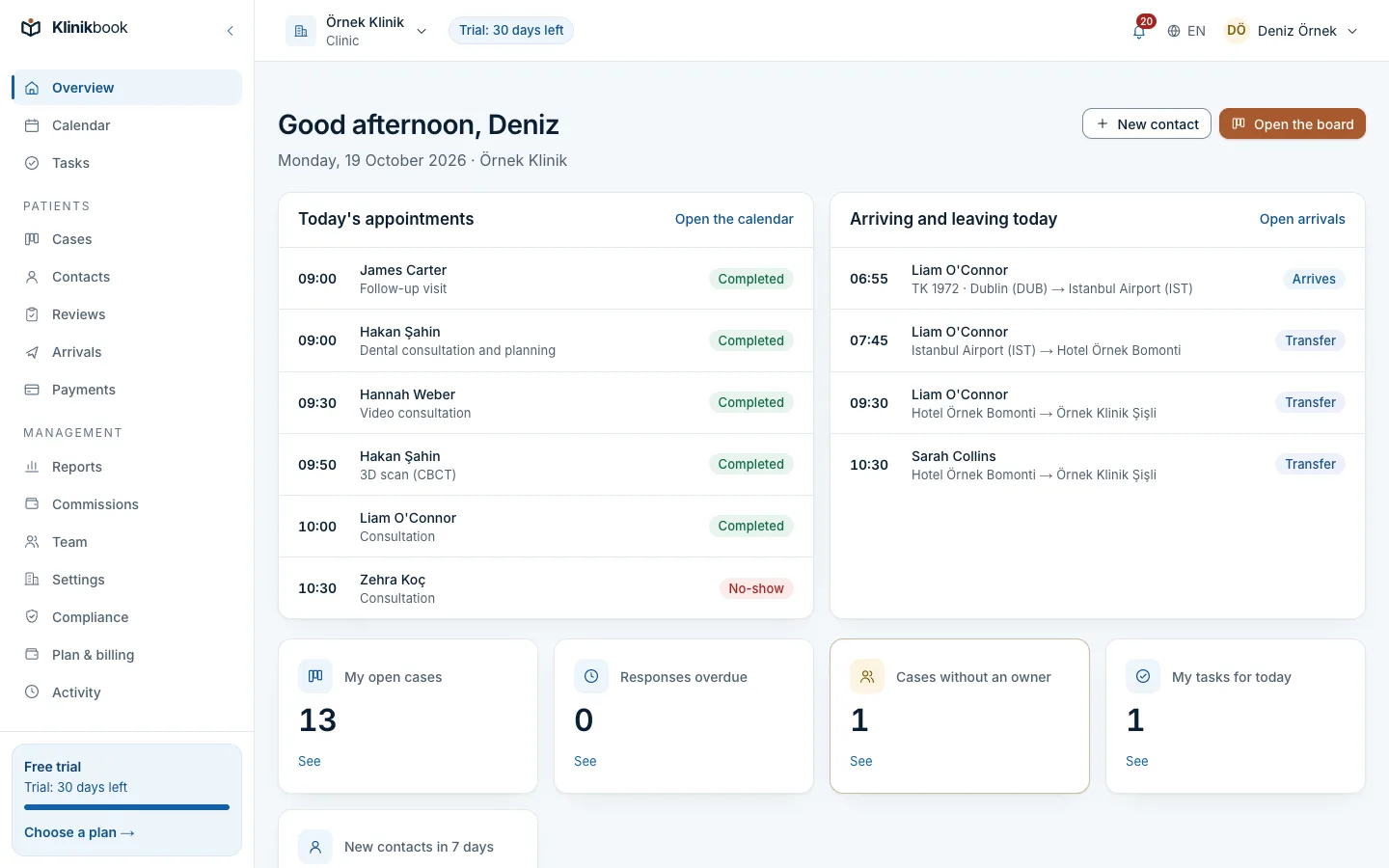
Use the one-tap call and WhatsApp links on the contact's record; the WhatsApp chat opens on your own phone.
Mark the no-shows
Marking an appointment as missed adds to the person's no-show count, and reports count the period's no-shows and cancellations.
Frequently asked questions
What is a normal no-show rate?
There is no figure that applies to everyone. A review of 105 studies found an average of around 23%, but the rate varied widely by region and specialty. Measure your own rate for a month, then track it the same way every month.
How many reminders should we send?
A booking confirmation plus one reminder 24–48 hours before that asks for an answer is a good starting point. Add a reminder a week ahead for appointments booked far in advance, and stop at three.
Text, e-mail or WhatsApp?
Most studies look at text messages and phone calls. Choose the channel your patients actually read, and confirm by phone or WhatsApp those who have no e-mail address or do not reply.
Can we charge patients who do not turn up?
That depends on what the patient agreed to in writing and on consumer law where you work. Put the terms in the quote and the booking confirmation, and check with a lawyer before applying them.
Does Klinikbook send SMS reminders?
No. Klinikbook sends booking details and reminders by e-mail, in the patient's language; for a phone or WhatsApp check, the team uses the one-tap links on the contact's record.
Sources
- No-shows in appointment scheduling – a systematic literature review (Dantas et al.) — Health Policy, vol. 122, no. 4, 2018
- Mobile phone messaging reminders for attendance at healthcare appointments — Cochrane, 5 December 2013
- MHRS Üzerinden Hastane Randevuları İçin “Randevuma Geleceğim” Onayı Alacağız (in Turkish) — Ministry of Health of the Republic of Türkiye, 17 April 2024
Related reading
30-day free trial
Try Klinikbook with your own team
Every feature is open for 30 days, and no card is needed to start.