On this page
Why is finding patients abroad different from finding local patients?
A local patient finds a clinic through the neighbourhood, an acquaintance or the doctor's name. A patient abroad gets to know you on a screen: a page in the language they search in, who the doctors are, what the price includes, and whom to trust before boarding a flight. The decision takes weeks, and the patient often writes to several clinics on the same day.
So the job is not only promotion. Findability, trust, price clarity and reply speed form one chain, and the weakest link decides the result. This guide covers each link and how to strengthen it within Turkish rules. It promises no patient numbers from any channel.
Which channels bring patients from abroad?
These channels are common in health tourism. Decide which works for you from your own enquiry records, not guesses.
- Multilingual website and search engines
- How it worksThe patient searches “hair transplant Istanbul” or the treatment in their own language and finds your pages on the service, the doctors and the price frame.
- Watch out forA separate URL per language and correct language tags; translate page content, not just the template. Know the rules for a site aimed abroad.
- Google business profile and maps
- How it worksA patient abroad checks that the clinic has a real place, opening hours and reviews.
- Watch out forThe profile must comply with the regulation; see our separate guide on review rules.
- Social media (account aimed abroad)
- How it worksContent introducing the doctor and the process and answering questions; enquiries by message.
- Watch out forFor an authorised channel, Article 8 conditions: publish the certificate, the HealthTürkiye logo, no targeting of Türkiye.
- Recommendations from past patients
- How it worksSatisfied patients tell family and friends; diaspora communities and patient forums amplify this.
- Watch out forDo not promise gifts or discounts for referrals; health promotion bans incentives and gifts, and platforms have their own rules.
- Authorised intermediaries
- How it worksA firm that makes first contact with the patient and has a protocol with you sends the patient your way.
- Watch out forA certificate and a written protocol are essential; record the source separately. See the checklist below.
- Trade fairs and events abroad
- How it worksDirect conversations and relationships that later become enquiries.
- Watch out forYour participation and materials are subject to the promotion rules; price and campaign content is possible only under the conditions for promotion abroad.
Which languages should you publish in?
Choose languages from your data, not guesses: look at the last 12 months of enquiries. Which countries and which languages did they come from? Doing the first two or three well beats doing ten sloppily. A single untranslated page costs the patient's trust at a glance.
According to Google Search Central documentation, each language version should have its own URL, versions should link to each other reciprocally (hreflang) and the content should really be translated; translating only the menu and footer is not enough. The journey after the enquiry must be in the same language too: the pre-assessment form, the quote and the reminders should reach the patient in their language.
What builds trust for a patient abroad?
- Your authorisation certificate and licence details: the facility's name, title and address match the site exactly.
- Doctors' names, titles and the specialty on their diploma; no invented titles.
- An address, a map and real office hours; a telephone number and a person they can write to.
- A description of the process: from enquiry to aftercare, what happens, when and who does it.
- A written statement of what the price covers (below).
- Patient stories: only on a channel aimed abroad, authorised, and with the patient's documented explicit consent.
- An aftercare plan: the patient knows they can still reach you once back home.
- A complaints and cancellation route, with conditions written out.
Price transparency: what a good international quote contains
Patients often ask for “the price”, but what they really want to know is what their money covers.
- Currency
- How to write it in the quoteThe currency common in the patient's country; who carries the exchange-rate risk.
- Included
- How to write it in the quoteTreatment, anaesthesia, medication, check-ups, interpreter, transfers, accommodation: item by item.
- Excluded
- How to write it in the quoteFlights, extra fees if further treatment is needed, extra nights.
- Deposit and balance
- How to write it in the quoteThe deposit amount, how to pay it, and when the balance is due.
- Validity
- How to write it in the quoteThe date until which the quote holds.
- Cancellation and refund
- How to write it in the quoteWhat happens if the patient withdraws or the clinic finds treatment unsuitable.
- Options
- How to write it in the quoteA more economical and a more comprehensive option, with the difference spelled out.
Why is reply speed one of the strongest competitive factors?
A patient sends the same message to many clinics, and the first substantive reply shapes the conversation. Response time is also among the performance criteria of the international health-tourism regulation: an organisation that answers more than 90 per cent of requests within two working days (48 hours) is rated adequate on it. Treat that as a floor, not a target.
Plan for time zones. If your office is closed during the hours when most patients write, replies wait until morning. Make it clear who looks at which hours, by shifts or round-robin assignment; our guide to responding to patient enquiries has the details.
A sample first reply
Subject: Your implant enquiry – next steps (Ref DK-0042)
Dear Mr. Becker, thank you for writing to us about dental implants. I am Elif, your patient coordinator, and I will look after your case from now until your return home. To let Dr. Can give you an honest assessment, could you send (1) a recent panoramic X-ray or 3-4 clear photos of your teeth, and (2) any medical conditions or medication we should know about? Once we have them, you will receive a written quote within two working days, showing exactly what is included. You can also book a 15-minute video call here: [link]. Best regards, Elif
This message works because it uses the patient's name, says who is looking after them, and states a concrete next step and a time frame. Prepare your own messages in the patient's language.
Checklist before working with intermediaries
For some clinics intermediaries are the main channel. Settle these points before you sign:
- The intermediary holds a valid international health-tourism authorisation and you can see the certificate number.
- You have a written protocol: who does what, which services are yours and which are the intermediary's.
- The patient knows where and to whom they pay for treatment; the flow of money is explained to them openly.
- What the intermediary tells the patient (price, results, timing) is approved by you.
- Who sees the patient's health data, the patient's consent and data responsibility (KVKK) are in writing.
- The intermediary is recorded as a separate source, so you can see how many enquiries and treatments each one brought.
- You have had your lawyer check the legal framework of any fee or commission arrangement.
Measurement: which numbers to watch
Calculate these indicators the same way each month and read them together, not one at a time.
- Enquiries (by country, language and source)
- What it tells youWhich channels and markets bring enquiries
- First-response time (median)
- What it tells youHow quickly enquiries are answered
- Enquiry to pre-assessment rate
- What it tells youThe seriousness of enquirers and the quality of the first reply
- Assessment to quote, quote to deposit
- What it tells youPrice, trust and the quality of the quote
- Deposit to treatment
- What it tells youTravel planning and drop-outs
- Cost per treated patient
- What it tells youA channel's real return
How is this done in Klinikbook?
Klinikbook does not bring you patients, run ads or take commission; it lets you track the enquiries you receive without losing any and see where they came from.
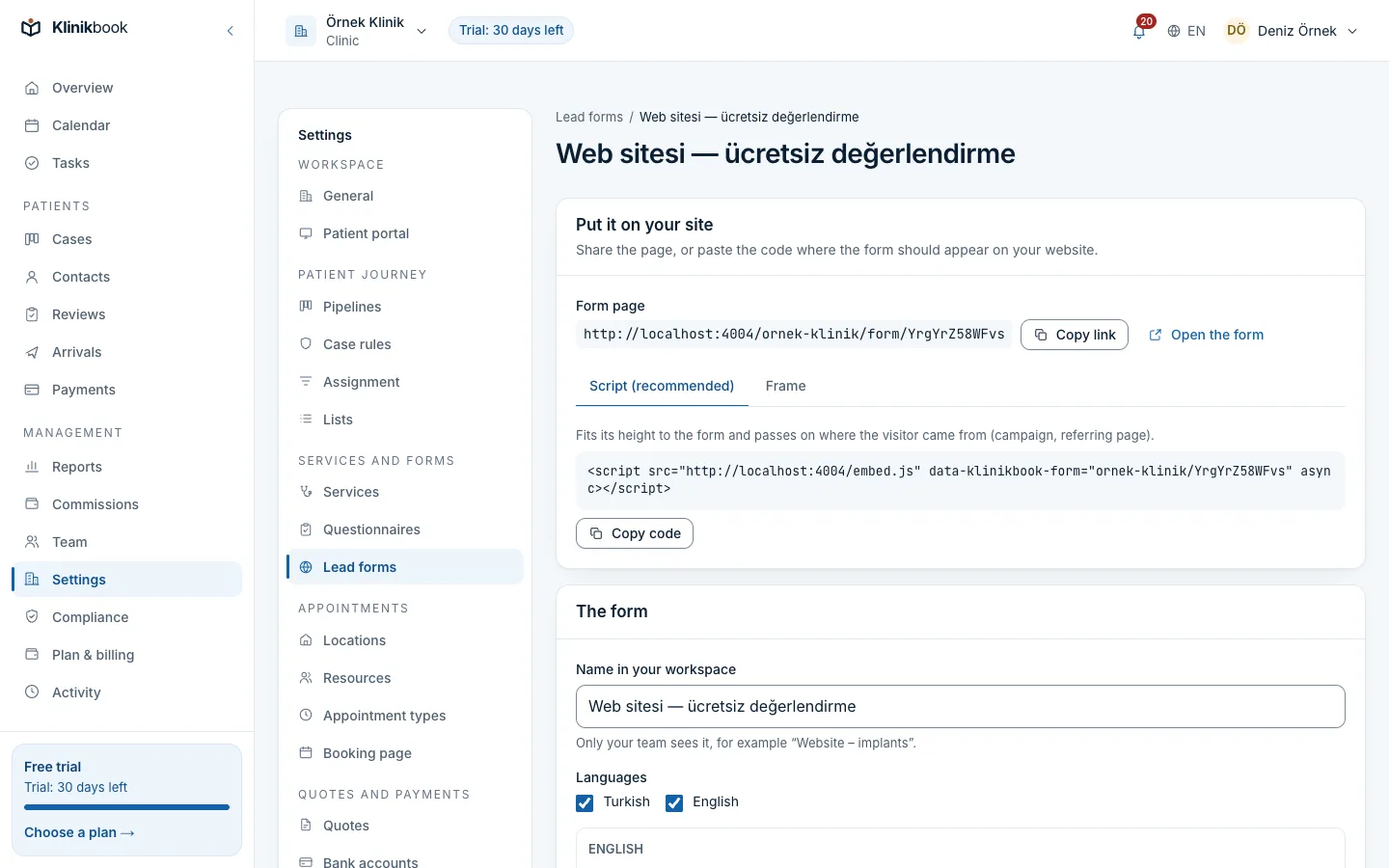
Make a lead form for each language and market
A lead form is hosted on its own page or embedded in your site. It records the UTM tags in the page address and the source on the case.
Separate the sources
Use a separate link for each intermediary, campaign and country, so the case card already shows where the enquiry came from.
Set a first-response target
Set the response target in case rules; round-robin assignment hands enquiries to coordinators in turn, and missed targets show on the board.
A quote and portal in the patient's language
The patient portal speaks Turkish, English, German, Arabic, Russian and French; the quote and pre-assessment open in the patient's language.
Read the source and funnel in reports
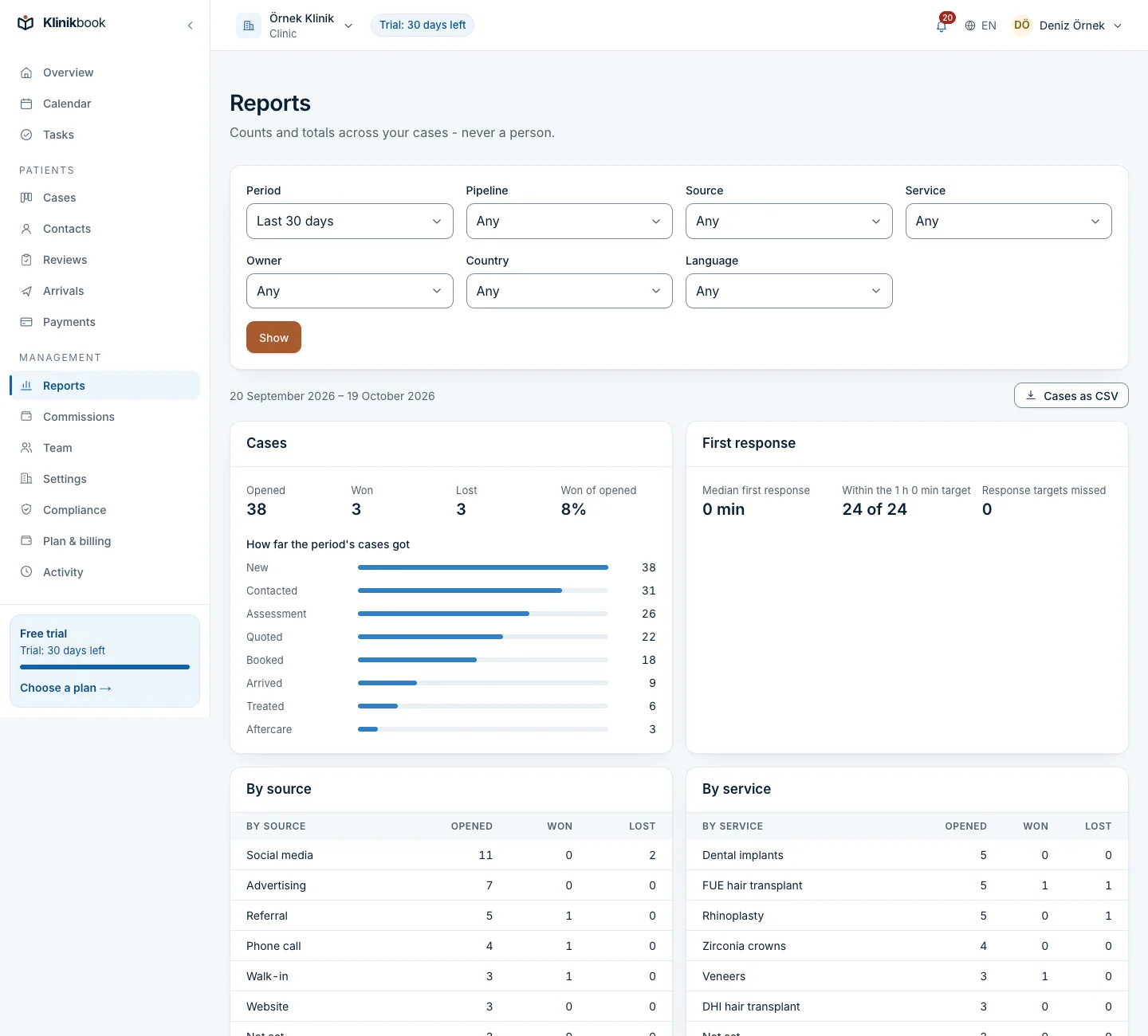
Reports show the conversion funnel by source and campaign, the median first response and results by service.
Lead form
Record the channel from day one
In the form settings you choose which services are offered, which pipeline opens and the source. UTM tags on the page are written to the case.
- Hosted page or embed code
- Source and campaign on the case
- Optional marketing-consent box
Reports
Which source turns into patients?
Conversion funnel by source, campaign and service; median first response; collections by month and currency.
- Period and source filters
- Cases won and lost
- Case export as CSV
Frequently asked questions
Which channel is best for finding patients abroad?
There is no single channel that works for everyone. A multilingual website, a Google business profile, recommendations from past patients and authorised intermediaries are common. Record the source of your enquiries and keep or drop a channel using your own numbers.
Do I need permission to advertise abroad?
Under Article 8 of the regulation, sponsored promotion aimed abroad is for facilities and intermediaries holding the Ministry's international health-tourism authorisation; the certificate is published, the HealthTürkiye logo is used and people living in Türkiye are not targeted. Ask the Ministry or your lawyer about your own position.
Can I give prices to patients abroad?
A written, personalised quote after the enquiry is the normal route. On an authorised channel aimed abroad, the regulation also allows discounts, campaigns and competitive price announcements; on channels aimed at people in Türkiye, prices and discounts may not be shared.
Which languages should I publish in?
Look at the last 12 months of enquiries and start with the two or three languages that bring the most. Translate the pages for real and publish each language at its own address. The Klinikbook patient portal speaks Turkish, English, German, Arabic, Russian and French.
What should I watch for when working with an intermediary?
A valid authorisation, a written protocol, clarity on whom the patient pays, who sees patient data, and recording the source separately are the main points. Ask your lawyer about the legal framework of any fee or commission arrangement.
Does Klinikbook bring in patients from abroad?
No. Klinikbook is not a marketplace, does not refer patients, does not advertise and takes no commission. It gathers the enquiries you receive in one place, records their source, assigns them to your team and reports on the process.
Sources
- Regulation on Promotion and Information Activities in Health Services, Article 8 (in Turkish) — Resmî Gazete, no. 33075, 12 November 2025
- Regulation on International Health Tourism and the Health of Tourists (in Turkish) — Resmî Gazete, 26 April 2025
- Annex EK-2 to the regulation: performance criteria (in Turkish) — Resmî Gazete, 26 April 2025
- Managing multi-regional and multilingual sites — Google Search Central, Current page
Gather your international enquiries in one place
Try Klinikbook free for 30 days, no card needed. Every plan has every feature.
Related reading
Free tools
30-day free trial
Try Klinikbook with your own team
Every feature is open for 30 days, and no card is needed to start.