Health advertising rules in Türkiye: what you may and may not post
Published 23 October 2026Reviewed 23 October 202611 min read
On this page
Is advertising banned in healthcare, and is information allowed?
The Ministry of Health's Regulation on Promotion and Information Activities in Health Services, published in the Official Gazette on 12 November 2025, prohibits covert or open advertising of health services and having it done for you. Promotion and information are allowed if certain conditions are met. The regulation repealed the earlier one of 29 July 2023, so guides written for the 2023 text are partly out of date.
It applies to three groups: health professionals, private health facilities and international health-tourism intermediaries. Law No. 3359 on Basic Health Services and consumer law sit beneath it, so the same post can be examined by both the Ministry of Health and the Ministry of Trade.
What can you post and what can't you?
The table summarises Articles 5, 7 and 8 of the regulation; read the article itself in borderline cases.
- Prices, discounts, campaigns
- Aimed at people in TürkiyeProhibited. Promotion may not include fees, discounts, campaigns or promotions.
- Authorised channel aimed abroadAllowed: discounts, campaigns and competitive price announcements may be made.
- Patient reviews, thanks, satisfaction
- Aimed at people in TürkiyeMay not be shared as advertising; patient reviews and thank-you messages are covered.
- Authorised channel aimed abroadPatient stories, reviews and thanks may be published if the patient's explicit consent is documented.
- Before-and-after images
- Aimed at people in TürkiyePossible with consent and conditions (below); a warning text is mandatory.
- Authorised channel aimed abroadThe same image rules apply; sponsored content aimed abroad is assessed separately.
- Sponsored (paid) posts
- Aimed at people in TürkiyeImages may not be published as sponsored or paid. Listing on search engines or platforms may be paid but may not aim to stand out.
- Authorised channel aimed abroadSponsored promotion in official languages other than Turkish is allowed, with the audience set to abroad.
- Audience
- Aimed at people in TürkiyeCompliant information may be open to everyone.
- Authorised channel aimed abroadPeople living in Türkiye may not be targeted; automatic audience features are switched off.
- Mandatory marks
- Aimed at people in TürkiyeA “results vary from person to person” warning on surgical and interventional images; a last-updated date and an editor contact on websites.
- Authorised channel aimed abroadThe authorisation certificate is published on the site or account; the HealthTürkiye logo is used.
Which posts get clinics into trouble on social media and websites?
From the prohibitions of Article 5, the ones clinics trip over most often:
- Price lists and “20% off this month” or “first 10 patients” style campaigns and promotions.
- Prize draws, gifts and incentives: health services may not be the subject of marketing activities.
- A patient review or a “thanks for choosing us” screenshot, even when the patient wrote it on their own account.
- Implying superiority over other providers, or unprovable claims such as “the best”, “the only” or “the regional leader”.
- Describing practices not proven scientifically or clinically and not established medical methods, or saying they treat disease.
- Using a certificate-based “specialist” title outside the specialty registered on the diploma.
- Telephoning people, or sending promotion by letter, SMS, e-mail or social messages, without their knowledge and consent.
- Announcements such as “check-up”, “health screening” or “free consultation” that steer people to a particular doctor or facility.
- Promoting a company or brand, or linking to one (for instance pushing a device brand).
- Presenting statistics or study results so that they suggest something different from what they show.
Can I post before-and-after photos?
Yes, but only by meeting every condition in Article 7. The article covers preventive and improving visuals. The key condition is the patient's explicit consent, which can be taken in writing or electronically using the “Visual Content Recording and Processing Consent Form” in Annex 1 of the regulation. The patient has the right to see the image before it is published and can withdraw consent at any time; a withdrawal is processed immediately.
The facility or professional must publish the image themselves. Having an agency post it does not remove your responsibility.
Checklist before posting an image
- The patient's explicit consent is taken in writing or electronically and kept on file.
- The patient saw the image before publication and knows how to withdraw consent.
- Nothing was paid, discounted or given in return for consent; a patient who declines was told treatment and fees stay the same.
- Before and after were shot in the same setting and with the same technique; no make-up or digital retouching.
- The procedure date and the viewing date are shown, and the image is stated to be of a real patient.
- No images during the procedure and no intimate areas.
- The post is not sponsored; comments, likes and reshares are switched off.
- For domestic posts, the warning that results may vary from person to person is easy to read.
How does promotion in a foreign language or aimed abroad work?
Article 8 gives facilities and intermediaries that hold a Ministry international health-tourism authorisation more room. The conditions: a separate social media account or website aimed abroad; a clear statement that health-tourism services are provided; the authorisation certificate published on the site or account; the HealthTürkiye logo on all channels aimed at health tourists; and a facility name, title and domain consistent with the title on the licence.
On this channel, sponsored promotion in official languages other than Turkish is allowed, the audience is set to abroad, and promotion aimed at creating demand among people living in Türkiye is not allowed. Medical procedures that are banned or not permitted in Türkiye may not appear. Intermediaries must stay within the intermediary services defined in the legislation, must not suggest they provide health care, and must say that the service is delivered by the partner facility they have a protocol with.
What happens if you break the rules?
Article 12 of the regulation says that where non-compliant promotion is found, the administrative sanctions in Additional Article 11 of Law No. 3359 apply to facilities and intermediaries. According to the law's text, the fine for private health institutions is up to two per cent of the previous month's gross service revenue, with a floor (the law states 100,000 TL; amounts are revalued every year, so check the current figure against the Ministry's announcement). If the same act is repeated within a year the fine is increased, and on a third occasion activity may be suspended for up to ten days.
For doctors and dentists who are not in independent practice, the older Law No. 1219 applies and their employer and professional body are notified; for other professionals the matter goes via the Ministry of Trade to the Advertising Board. Access to harmful content can be blocked, and personal-data breaches are handled separately under KVKK.
Where do the Ministry of Trade and the Advertising Board come in?
The health regulation is the special rule; the general advertising rules still apply. The Regulation on Commercial Advertising and Unfair Commercial Practices requires advertising to be truthful, not deceptive, recognisable as advertising and not covert, and verifiable claims must be provable. Advertising for health services must also comply with the specific provisions of the relevant legislation. The regulation rests on the advertising provisions of Consumer Protection Law No. 6502, under which the Advertising Board decides.
One change published on 1 July 2026 is relevant: influencer posts made in return for a benefit (payment, a discounted product, an event invitation) must carry a clear label such as “advertisement” or “promotion”. A clinic working with an influencer is already restricted by the health regulation, but the label rule shows that hiding a post's promotional nature is a separate breach.
Doctors' personal accounts and staff posts
The regulation holds those who post non-compliant promotion and those who share it equally responsible. A doctor resharing the clinic's campaign from a personal account, or a coordinator putting a patient's thank-you message on their own Instagram story, can be as problematic as a post on the clinic's account. A written social-media policy for staff is the cheapest safeguard: what goes on which account, who approves patient images, and why screenshots of patient messages are never shared.
A patient's screenshot or photo can also be health data. Sharing it without the patient's explicit consent breaches KVKK as well; see our KVKK guide.
How is this done in Klinikbook?
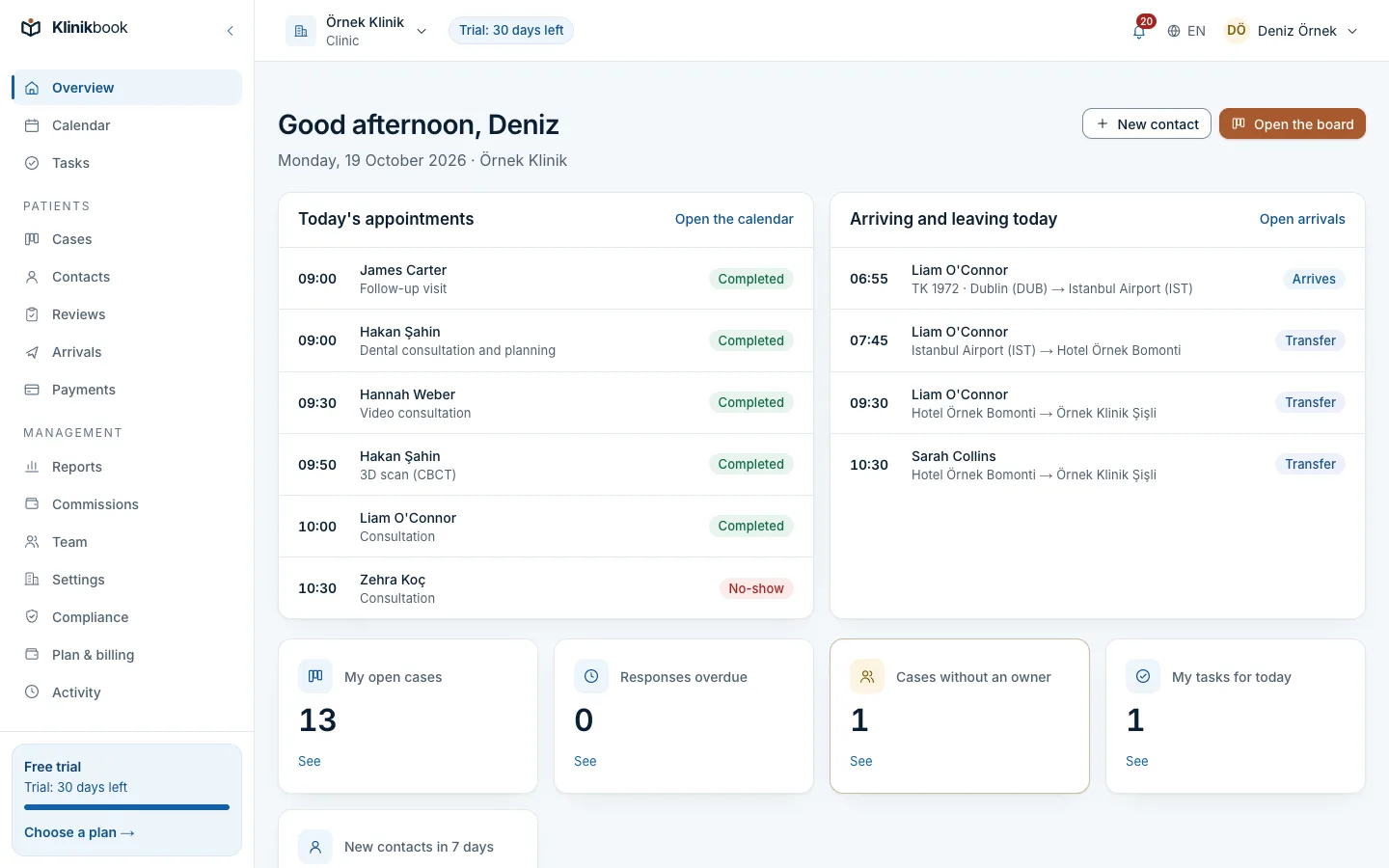
Klinikbook does not vet your posts, run ads or publish to social media; it helps you keep consents and records in order.
Publish the photo and video consent from a template
The compliance centre has photo/video and marketing consent templates. Edit the text for your clinic and publish it; have your lawyer check it against the form in Annex 1 of the regulation.
Let the patient give consent in the portal
Patients give photo and marketing consent in the portal in their own language. Each decision is kept on the person's card with its channel and date, and the patient can withdraw it.
Record the scope of marketing consent
The marketing consent box records only the channels the patient chose. On Türkiye workspaces the contact card also holds the IYS status field.
Make a withdrawal visible
When a patient withdraws consent, the record on the contact card and a task on the case make clear who on the team takes the image down.
Compliance centre
Consent texts are published in versions
Privacy notice, explicit consent, photo/video and marketing consent are separate texts. You can later show which version a patient agreed to and when.
- A version and publication date per text
- Consent on the person's card with channel and date
- The patient reads it in their own language
What the patient sees
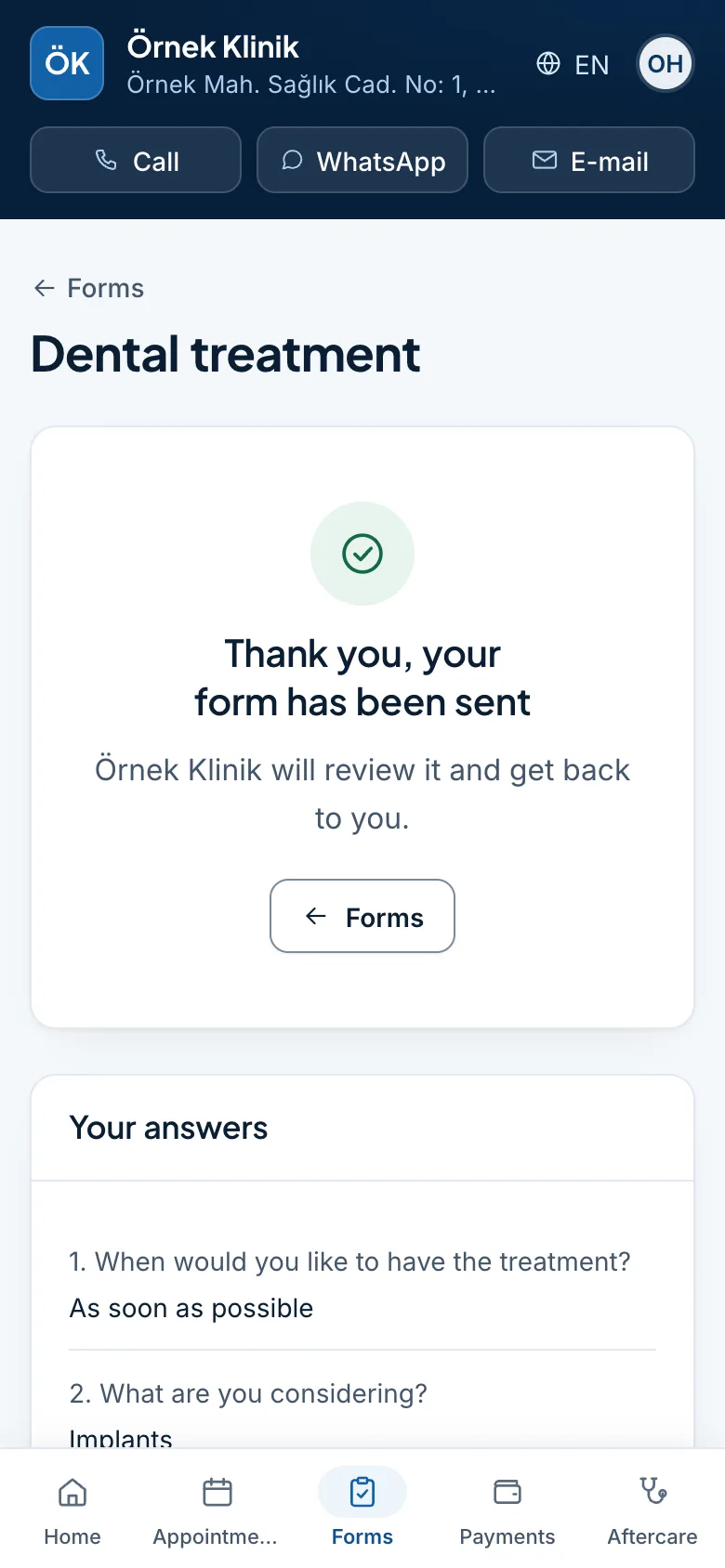
The patient gives consent in the portal themselves
Consent is taken during pre-assessment on the patient's own phone. No paper goes round and the record does not get lost.
- A patient who declines consent is still processed
- A clear way to withdraw
Frequently asked questions
Can a clinic post prices on Instagram?
Not on an account aimed at people in Türkiye: Article 5 of the regulation bars fees, discounts, campaigns and promotions from promotion. If you are an authorised facility or intermediary with a separate account aimed abroad, Article 8 allows discounts, campaigns and competitive price announcements.
Can I share my patients' reviews or thank-you messages?
Not on channels aimed at people in Türkiye; the regulation bans advertising-style sharing of patient reviews and thank-you messages. On the site aimed abroad of an authorised facility, patient stories and reviews may be published if the patient's explicit consent is documented.
Is sharing before-and-after photos allowed?
Under conditions. You need the patient's explicit consent, their right to see the image first, the same setting and technique, dates, no sponsorship and interaction switched off; images taken during a procedure and of intimate areas may not be shared. For domestic posts the “results vary” warning is mandatory.
Can I run paid ads on Google?
The regulation lets facilities and professionals register on search engines and social platforms; the listing may be paid or sponsored but may not aim to stand out, and keywords and result-page information must also comply. Sponsored image posts are banned. Check your plan with your provincial health directorate or lawyer before it goes live.
If an agency does my marketing, is the agency responsible?
No. The regulation requires image posts to be made by the facility or professional and says that posting by others does not remove their responsibility. Set up a written approval process with the agency.
How big are the fines?
Under Law No. 3359, private health institutions face an administrative fine of up to two per cent of the previous month's gross service revenue, not below a floor written into the law, and higher on repetition. The floor is revalued yearly, so check the current amount in the Ministry's announcements.
Is this page legal advice?
No. It summarises the main lines of the regulation. For anything that needs interpretation, ask your provincial health directorate, your professional body or your lawyer.
Sources
- Regulation on Promotion and Information Activities in Health Services, Articles 5, 7, 8, 12 (in Turkish) — Resmî Gazete, no. 33075, 12 November 2025
- Law No. 3359 on Basic Health Services, Additional Article 11 (in Turkish) — Ministry of Health, Current text
- Regulation on Commercial Advertising and Unfair Commercial Practices (in Turkish) — Resmî Gazete, no. 29232, 10 January 2015 (as amended)
- Amendments to the advertising regulation, including the influencer label (in Turkish) — Ministry of Trade, 1 July 2026
- Regulation on International Health Tourism and the Health of Tourists (in Turkish) — Resmî Gazete, 26 April 2025
Keep consents and records in order
Try Klinikbook free for 30 days, no card needed. Every plan has every feature.
Related reading
30-day free trial
Try Klinikbook with your own team
Every feature is open for 30 days, and no card is needed to start.