How to take payment from and invoice foreign patients
Published 23 October 2026Reviewed 23 October 20268 min read
On this page
The payment flow: who does the patient pay?
The regulation does not fix the payment flow; the facility's price must follow the Ministry's health tourism tariff rules (art. 11). Three common arrangements:
- Patient pays the facility; the intermediary invoices its own services
- How it worksThe treatment fee goes to the facility, which invoices it; the intermediary invoices accommodation, transfers and advice separately
- Watch forDivision of responsibility is clear; the intermediary does not hold the patient's treatment money
- The intermediary collects and pays the facility
- How it worksThe patient pays the whole amount to the intermediary, which pays the facility
- Watch forTax and invoice consequences differ (see below); set it up with an accountant
- An insurer, a foreign social security body or an authorised agency is invoiced
- How it worksThe facility invoices that body instead of the patient
- Watch forPer the ruling, the invoice must also show the date of last entry into Türkiye
The VAT exemption (VAT Law art. 13/1-l): conditions
- Who provides the service
- What the law saysA natural or legal person authorised by the Ministry of Health
- NoteA 2020 ruling says the exemption cannot be applied in a hospital's invoice to a company that is not an authorised agency
- Who receives it
- What the law saysA foreign-national natural person who is not resident in Türkiye
- NoteThe ruling does not define residence; ask your accountant
- Where
- What the law saysExclusively within health institutions
- Note-
- Type of service
- What the law saysPreventive medicine, diagnosis, treatment and rehabilitation
- NoteAesthetic procedures are outside, according to the rulings
- Supplied alongside
- What the law saysOther supplies and services given with these services are not covered
- NoteAccommodation, transport and meals are the examples given
Aesthetics, hair transplants and dentistry: is there an exemption?
The 2020 ruling treats hair transplants, skin care, wrinkle treatment and filler applications as aesthetic and outside the exemption; the 2025 ruling says an aesthetic nose operation cannot be VAT-exempt under this provision. So a provider of hair transplants or aesthetic services should ask its accountant, and if needed the Revenue Administration, before issuing a VAT-free invoice to a foreign patient.
For medical procedures such as dental treatment and surgery the answer also depends on the nature of the procedure; this page cannot say which procedure falls into which category. We give no VAT rate: the rate that applies to services outside the exemption may change, so ask your accountant for the current one.
What should be on the invoice?
According to the 2020 ruling, for the exemption to apply the invoice and documents should show:
- The patient's first name and surname
- Nationality
- Passport number (or Blue Card number)
- The nature of the service
- The fee for the service
- The date of last entry into Türkiye, if the invoice goes to an insurer, a foreign social security body, an authorised agency or, in countries with a bilateral agreement, SGK, instead of the patient
- A copy of the patient's passport kept on file (one commentator recommends this; ask your accountant)
The intermediary's invoice: two special cases
The 2020 ruling distinguishes an authorised agency from any other company. Here is what it says; get your own accountant's view for your situation:
- An authorised agency passes the amount it pays the hospital on to the patient one to one
- Result according to the rulingNo VAT is calculated on the intermediation
- An authorised agency shows a difference above the amount passed on, or a separate commission
- Result according to the rulingThat part is subject to VAT at the general rate
- The company is not an authorised agency
- Result according to the rulingThe exemption cannot be applied in the hospital's invoice to the company; any difference or commission the company shows is also subject to VAT
The corporate and income tax deduction
Under the provision cited in the 2025 ruling (13 May 2025), businesses authorised and supervised by the relevant ministry may deduct 80% of the profit from health services given to people not resident in Türkiye. The conditions listed include: health services must be among the declared main activities; the invoice must be issued in the foreign person's name; the service must actually be delivered (consultancy and intermediary work do not count); income and expenses must be tracked separately; and all the proceeds must be brought to Türkiye by the deadline for the annual return. This is a summary: ask your accountant whether the deduction applies to you and what you must report.
Invoices and documents under the regulation
- Art. 12/1
- What it requiresA sales receipt or invoice is given to the service user, with an itemised statement of services and unit prices attached
- Art. 12/1-a
- What it requiresOn request and free of charge the facility gives the list of medicines and consumables used, lab and radiology results (except forensic cases) and prescriptions for medicines bought elsewhere
- Art. 12/1-b
- What it requiresOn request and free of charge the intermediary gives an itemised statement of the accommodation, transport, transfer, interpreting and consultancy fees for companions and relatives
- Art. 11
- What it requiresThe facility must follow the procedures in the Ministry's health tourism price tariff
How do you run payments in practice?
The order depends on the flow you set up with your accountant; the basic steps are these:
Separate the lines in the quote
Write treatment, accommodation, transfer, interpreting and advice as separate lines; who sells which line decides the invoice.
Fix the deposit and due dates in writing
Show the deposit and balance amounts, their due dates and the cancellation terms in the quote (see the cancellation-policy guide).
Agree the payment method with your own bank
For a transfer from abroad, settle the IBAN and SWIFT details, who bears the charges and the currency with your bank; for card payments, the terms of your payment provider.
Ask the patient for the receipt
After paying, the patient uploads the transfer receipt; once you see the money in the bank you approve or reject it.
Issue the invoice and file it
Issue the official invoice, attach it to the case with the passport details and last entry date, and send it to the patient.
Record refunds and cancellations
If there is a refund or cancellation, record the reason and amount; your accountant makes any invoice correction.
How does this run in Klinikbook?
Klinikbook does not issue the invoice; it provides the records and follow-up. You issue the official invoice in your own system.
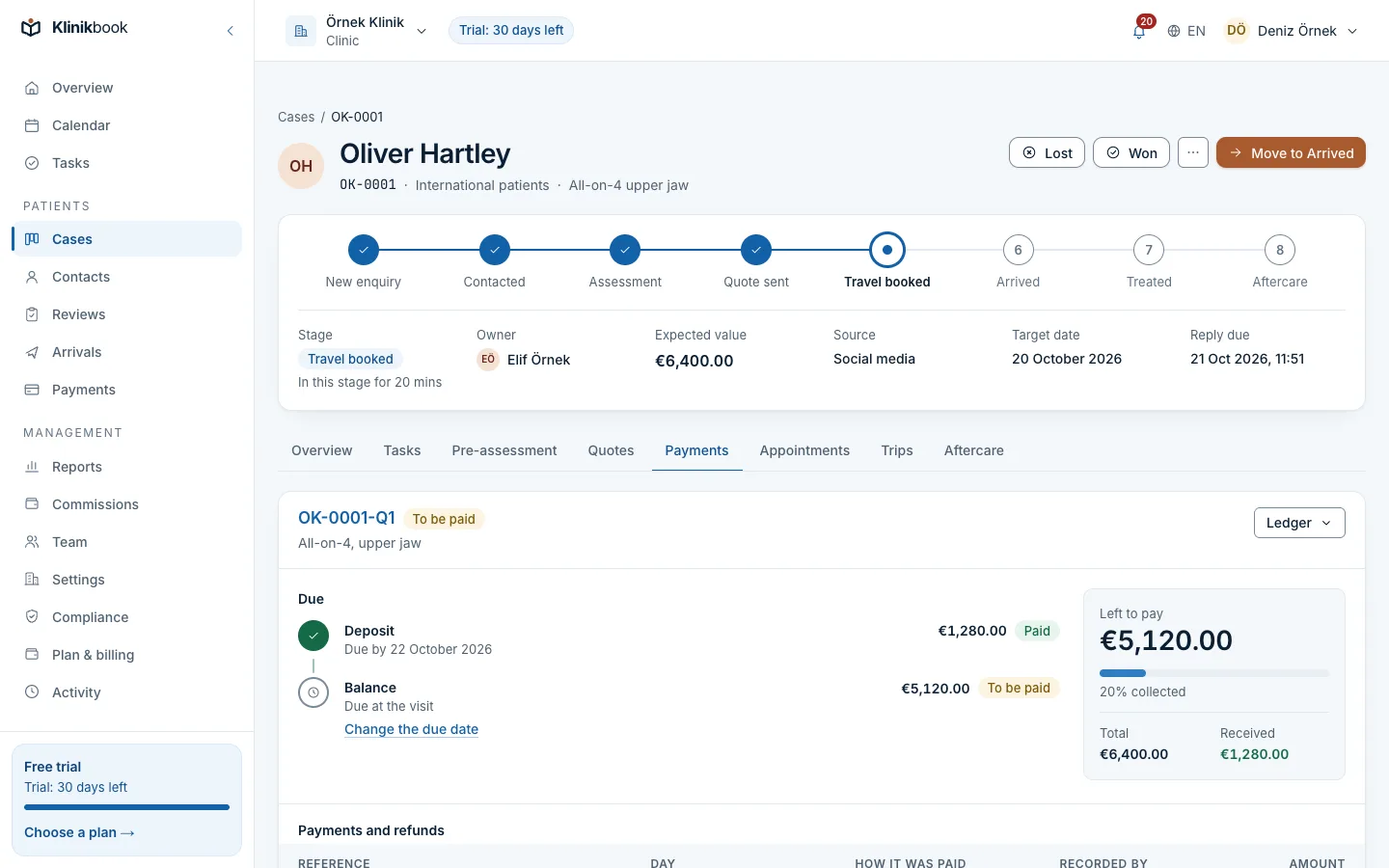
Quote and payment schedule
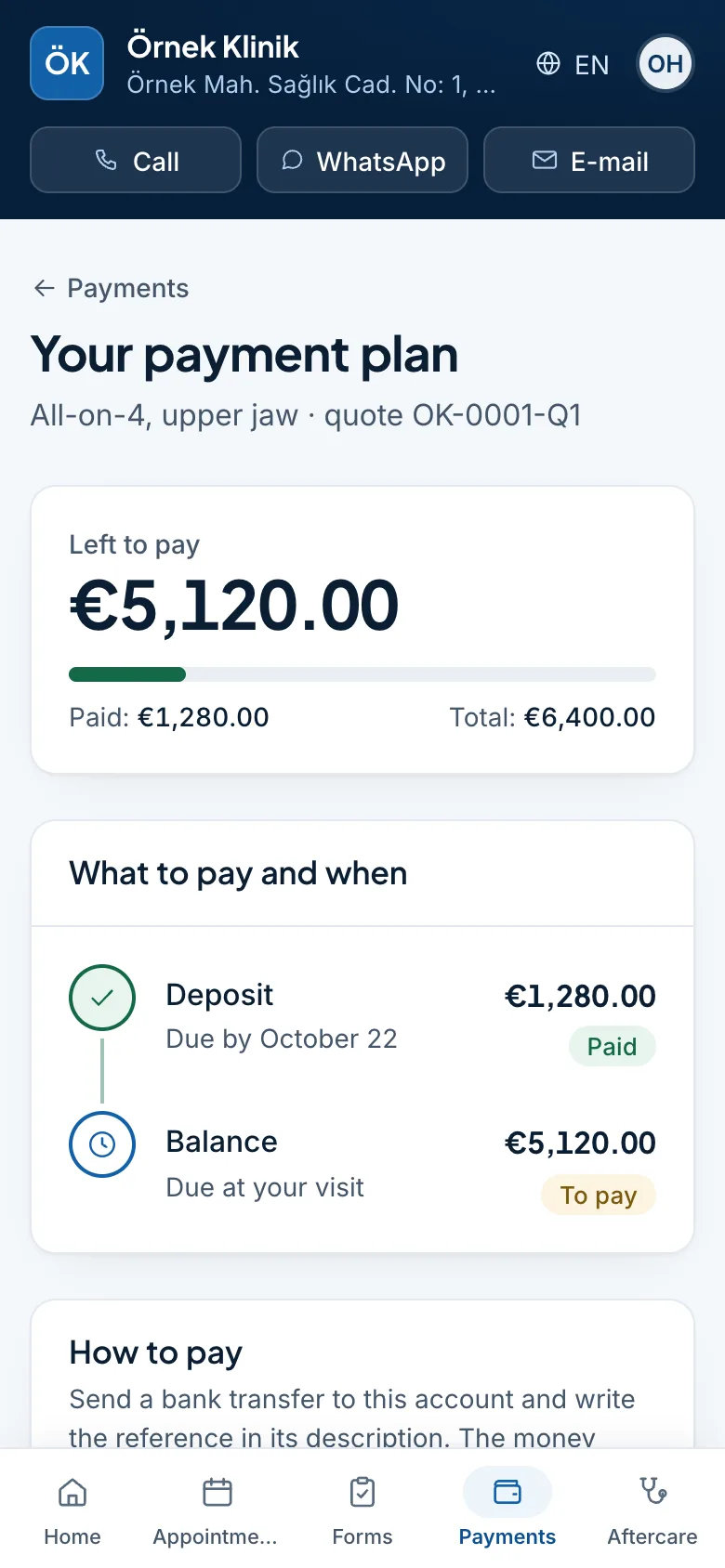
When the quote is accepted, the deposit and balance become a payment schedule with due dates; the patient sees the plan in the portal.
Bank account and receipt
The clinic's bank accounts are set up with IBAN checks; the patient uploads the receipt in the portal and you approve or reject it.
Collections, refunds, cancellations
You record collections, refunds, cancellations and due-date changes; the payment list downloads as CSV and reports show collections by month and currency.
Reminders
You can switch on reminder emails to the patient as a deposit or instalment approaches and when it is overdue.
Frequently asked questions
Can I issue a VAT-free invoice to a foreign patient?
If the conditions are met. VAT Law art. 13/1-l gives an exemption when a Ministry-authorised provider gives preventive medicine, diagnosis, treatment or rehabilitation inside a health institution to a foreign national not resident in Türkiye. Aesthetic procedures are outside it according to the rulings; ask your accountant about each case.
Does the exemption cover hotel and transfer charges?
No. The law does not include other supplies and services provided with these services, and the rulings give accommodation, transport and meals as examples.
What must the invoice show?
According to the 2020 ruling, the patient's first name and surname, nationality, passport number (or Blue Card number), the nature of the service and the fee. If the invoice goes to an insurer, a foreign social security body or an authorised agency, the date of last entry into Türkiye is needed as well.
Whom should the patient pay for treatment?
The regulation does not say. If the patient pays the facility for treatment and the intermediary invoices its own services separately, the split of responsibility is clear; still ask your accountant about the tax effects.
What should I do when the money arrives from abroad?
Settle the transfer details (IBAN, SWIFT, currency, who bears the charges) with your bank and ask your accountant about the tax effects of bringing the income to Türkiye; this is named as a condition of the 80% deduction.
Does Klinikbook take payments or issue invoices?
No. Klinikbook never holds or moves money and does not issue official invoices; it records and tracks the payment schedule, collections, refunds and receipts you agree with the patient.
Follow the payment schedule and collections in one place
Quote, deposit, instalments and receipt inside the same case. 30 days free, no card.
Sources
- Value Added Tax Law no. 3065, art. 13/1-l (exemption for health services to foreign nationals) — Mevzuat Bilgi Sistemi
- Health services given in Türkiye to foreign nationals not resident there (İstanbul Tax Office Directorate ruling, 29 January 2020; read on a secondary site) — Alomaliye (republication of the ruling), 29 January 2020
- Deduction on health services to non-residents (İstanbul Revenue Office ruling, 13 May 2025; read on a secondary site) — Alomaliye (republication of the ruling), 13 May 2025
- VAT exemption and corporate tax deduction for health services to foreigners (commentary, not an official source) — MuhasebeTR, 3 May 2024
- Regulation on International Health Tourism and Tourist Health, no. 32882 (arts. 11 and 12) — Resmî Gazete, 26 April 2025
Related reading
30-day free trial
Try Klinikbook with your own team
Every feature is open for 30 days, and no card is needed to start.