How to plan transfers, accommodation and interpreting for foreign patients
Published 23 October 2026Reviewed 23 October 20268 min read
On this page
Who may organise what?
- Accommodation, transport, transfers
- Who, under the regulationAuthorised travel agencies. An intermediary that is itself an authorised agency may do it directly
- NoteArt. 6/2-a (Travel Agencies Law no. 1618)
- Interpreting
- Who, under the regulationThe facility's international health tourism unit; at least one staff member's foreign language must be documented
- NoteArts. 7/1 and 7/2
- A responsible staff member per patient
- Who, under the regulationThe facility names one for each patient and records them on the Portal
- NoteArt. 7/4
- Call centre
- Who, under the regulationIntermediary: at least two foreign languages, 24/7
- NoteArt. 6/2-b
- Companions and relatives
- Who, under the regulationOn request the intermediary gives, free of charge, an itemised statement of accommodation, transport, transfer, interpreting and consultancy fees
- NoteArt. 12/1-b
How do you plan the patient's journey in order?
The order below is a good-practice suggestion; none of the timings is a legal requirement, and they vary with the treatment.
Before the quote is accepted: the stay frame
Get the treatment days, follow-up appointments and the earliest date the patient is fit to fly from the doctor in writing. The accommodation and transfer lines in the quote should rest on those dates.
After acceptance: flights and hotel
If the patient books their own flights, ask for arrival and departure times in writing. For the hotel, ask about cancellation and date-change terms in light of treatment days, arrival time and a possible longer stay.
A few days before arrival: confirmation
Keep flight number, travellers, hotel booking name and transfer meeting details in one place. Get the transfer firm's time, vehicle and driver contact confirmed.
Arrival day: the meeting
Did the greeter actually meet the patient, did the patient reach the hotel, and is the first appointment clear? Record the answer to all three.
Treatment days: coordination with the facility
The facility's responsible staff member should share appointment times, where patient and interpreter meet, and discharge time with you. Tie transfer times to these rather than fixing a time in advance.
Return and follow-up
Write down the last check before the flight, the airport transfer and the follow-up plan after the patient gets home (aftercare) in advance.
What to confirm in the transfer plan
- Airport pick-up
- What to confirmFlight number, landing time, waiting time, name board, driver's phone
- WhoTransfer firm, coordinator
- To the hotel
- What to confirmLuggage and wheelchair needs, seat height, extra passengers
- WhoTransfer firm
- Hotel to clinic or hospital
- What to confirmAppointment times, round trip, margin for rush hours
- WhoCoordinator
- After surgery
- What to confirmVehicle for discharge to the hotel; has the doctor been asked whether the patient needs to lie down
- WhoFacility, coordinator
- Return
- What to confirmDeparture time, time to reach the airport, extra luggage needs
- WhoTransfer firm
What to ask when choosing a hotel
- Travel time and route to the facility where treatment takes place
- Lift, entrance steps and bathroom access (ask the doctor about post-operative limits)
- Dietary limits and meal-time flexibility
- Rest conditions in the room, cleaning and room service
- Room extension if the stay is longer; cancellation terms for an early departure
- An extra bed or connecting room for the companion
- Someone at reception who speaks the patient's language, or translation support
- A written agreement with you and the invoicing arrangement (in whose name the charge is billed)
Interpreting: who provides it and how does it work?
The regulation sets up the facility's international health tourism unit for admission, registration, diagnosis, treatment, invoicing, discharge, interpreting and coordination with the intermediary. So for communication inside the treatment, the facility is responsible for interpreting. The intermediary may set up its own language support for the person who stays with the patient on arrival, at the hotel and on transfers. The regulation does not set a separate certificate or qualification for interpreters (not in the text we read); it is up to you to ask the facility and whoever provides the interpreting how they work.
As good practice we suggest: give consent and information texts in the patient's language in writing; do not use the companion as interpreter at the consent discussion; let the interpreter speak to the doctor about medical terms beforehand; agree with the facility how much information the interpreter may be given. Ask a lawyer about the legal validity of consent texts.
What to do when something goes wrong
- Flight delayed or cancelled
- Ask firstTransfer firm and hotel; update times and booking
- ThenIf a treatment appointment is affected, the facility's responsible staff member
- Patient has to extend the stay
- Ask firstDoctor or facility (medical reason)
- ThenHotel extension, return flight, whose account the extra costs go to
- Patient is not fit to fly
- Ask firstDoctor
- ThenChanging the return, extra accommodation, insurance position
- Suspected complication
- Ask firstThe facility's responsible staff member and the doctor; call 112 in an emergency
- ThenNote the records needed; responsibility for complications is shared according to the type of service between facility and intermediary (art. 6/3)
- Complaint
- Ask firstTake it in writing and log it
- ThenThe regulation requires complaints to be assessed and corrective and preventive action taken (art. 6/4)
How do you follow the journey in Klinikbook?
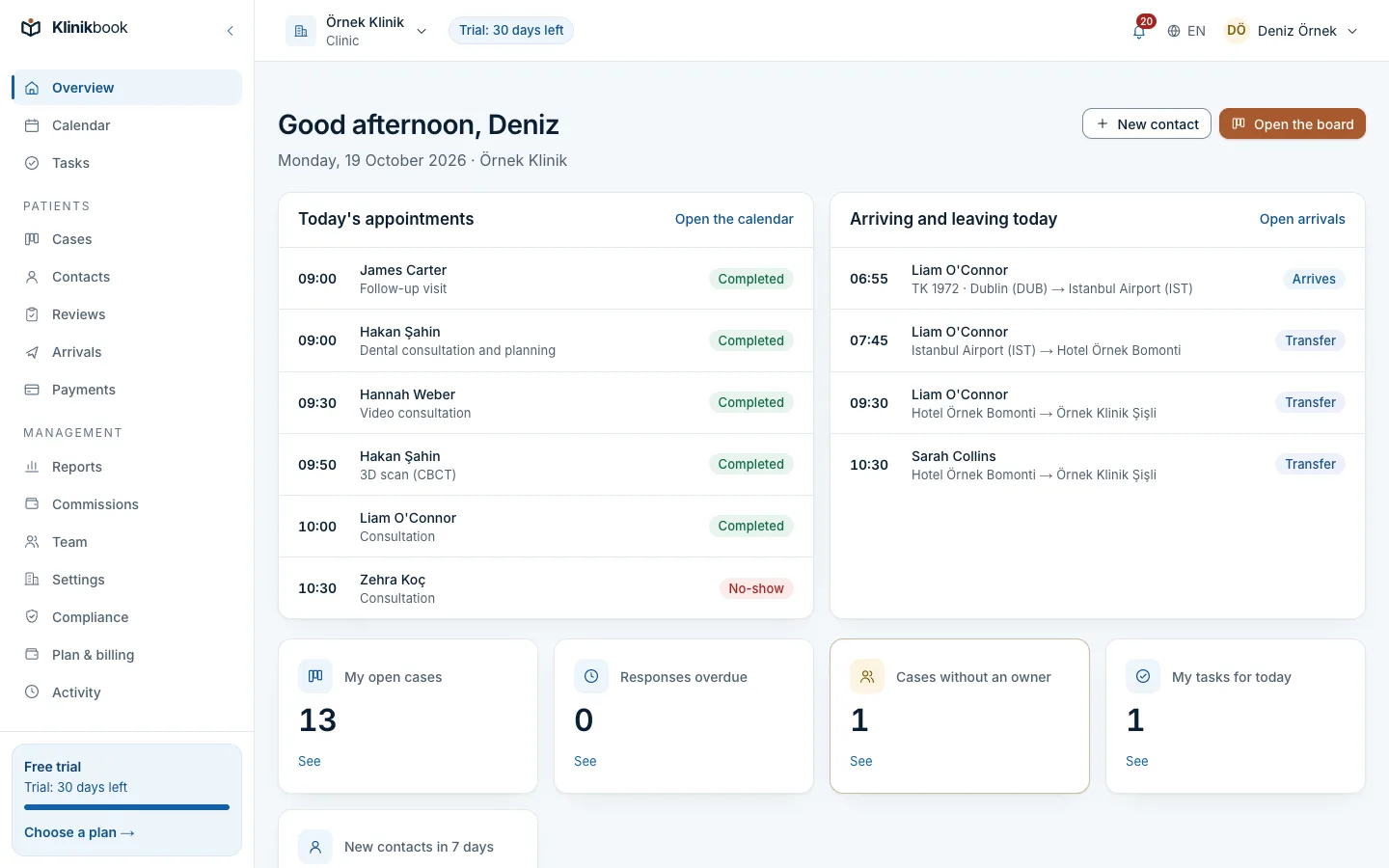
Klinikbook does not sell travel or make flight or hotel bookings; it keeps the plan you have made in one place on the case.
Add the trip to the case
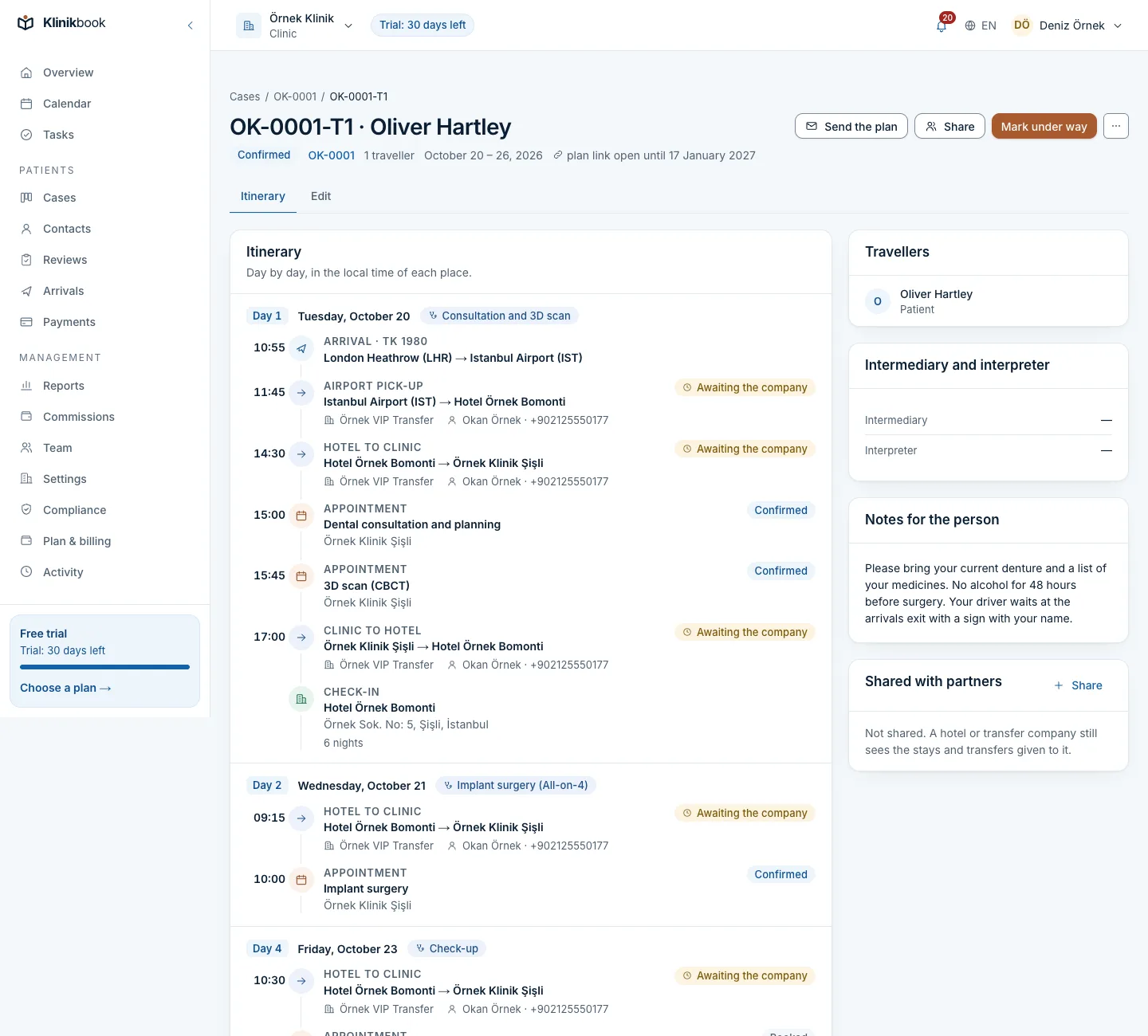
Travellers, flights (with arrival and departure in local time), accommodation, firm-confirmed transfers and treatment days sit in the case's trip.
Follow the status
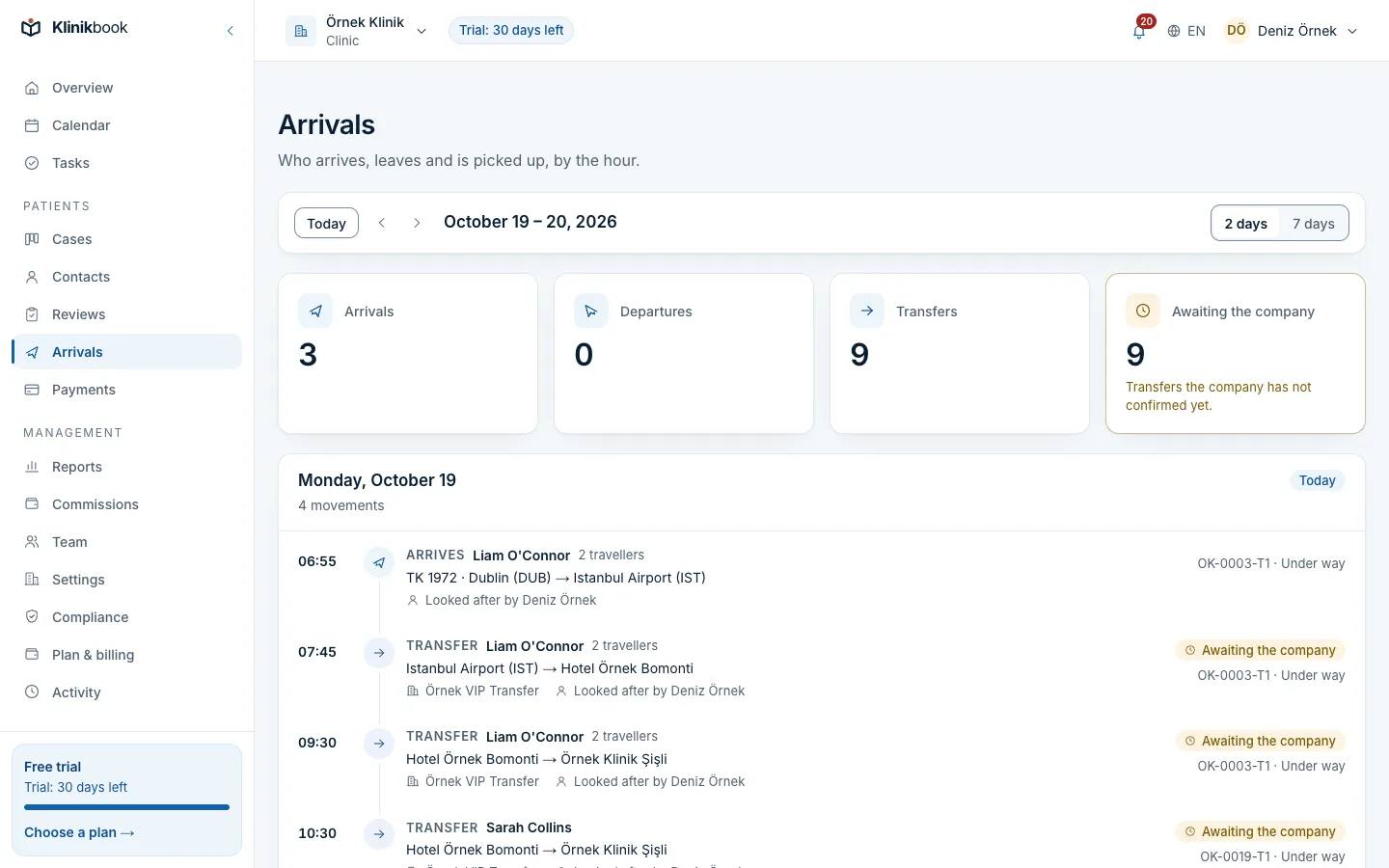
Trip statuses move on when the time comes; the arrivals board shows arriving patients and document warnings.
Show a partner only what is needed
When you share with a hotel or transfer firm you choose which of the contact name, travellers, flights, accommodation, transfers, treatment days and appointments they see; the partner guest is notified by email.
Show the patient in the portal
The patient sees the trip plan in the portal in one of six languages.
Trip
Flights, hotel, transfers and treatment days in one plan
In a case's trip, travellers, flights, accommodation, firm-confirmed transfers and treatment days sit side by side.
- Flight times in local time
- Firm-confirmed transfers
- Sharing with a partner by chosen fields
Frequently asked questions
Can I arrange the hotel and transfers myself?
Under the regulation, accommodation, transport and transfers go through authorised travel agencies; an intermediary that is itself an authorised agency may do it directly. If you have no authorised agency of your own, put these services under a contract with an agency.
Who provides the interpreter?
For communication inside the treatment, interpreting is the job of the facility's international health tourism unit. The intermediary may set up separate language support for the person with the patient on arrival and at the hotel. We found no separate certificate requirement for interpreters in the regulation.
Whose account does a companion's cost go to?
That depends on the contract between you and the patient. The regulation has the intermediary give, on request and free of charge, an itemised statement of the accommodation, transport, transfer, interpreting and consultancy charges for companions and relatives. See the guide on payments from foreign patients for invoicing.
How many days should the patient stay after surgery?
Only the treating doctor can say; it varies with the treatment and the patient. Build the quote and the accommodation on the doctor's written advice.
Do I need to give the hotel and the transfer firm patient information?
No. Diagnosis and treatment information is not needed for their work. Name, flight, arrival time and, if the patient wishes, accessibility needs are enough. Settle the basis for sharing with a lawyer under the KVKK.
Does Klinikbook book flights or hotels?
No. Klinikbook does not sell travel or make reservations; it keeps the flight, hotel and transfer plan you have made on the case and shares the fields you choose with your partner.
Keep the trip plan in one place
Flights, hotel, transfers and treatment days inside the case. 30 days free, no card.
Sources
- Regulation on International Health Tourism and Tourist Health, no. 32882 (arts. 4, 6, 7, 12) — Resmî Gazete, 26 April 2025
- The regulation's current text — Mevzuat Bilgi Sistemi, checked 23 October 2026
- Documents to be submitted by an intermediary (travel-agency contract) — USHAŞ
Related reading
30-day free trial
Try Klinikbook with your own team
Every feature is open for 30 days, and no card is needed to start.